Saturday, October 18, 2008

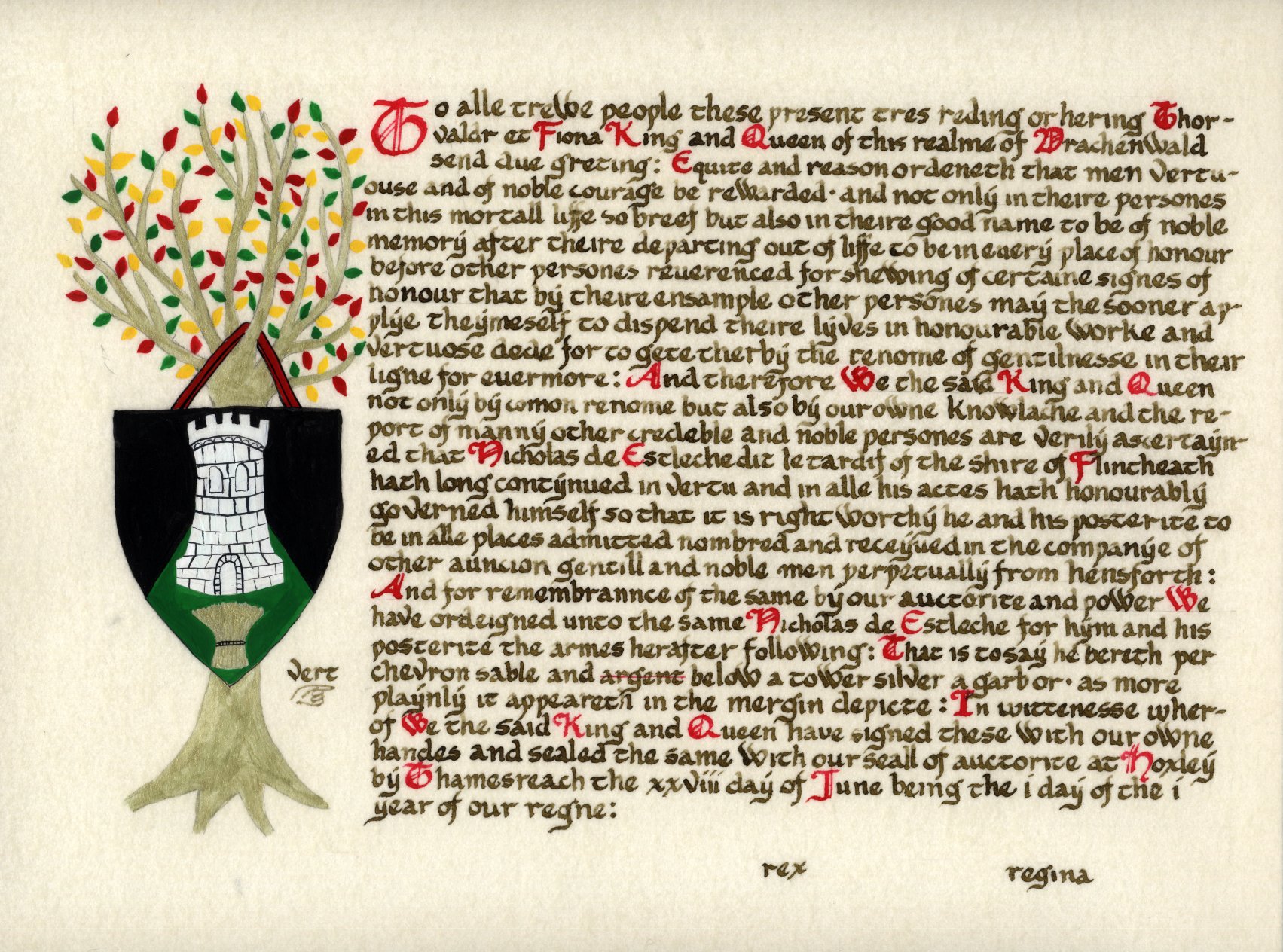
AoA for Nicholas de Estleche dictus le Tardif

Nicholas

The text reads: To alle trewe people these present tres reding or hering Thorvaldr and Fiona King and Queen of this realme of Drachenwald send due greting. Equite and reason ordeyneth that men vertuouse and of noble courage be rewarded, and not only in theire persones in this mortall liffe so breef but also in theire good name to be of noble memory after theire departing out of liffe to be in euery place of honour before other persones reuerenced for shewing of certaine signes of honour that by theire ensample other persones may the sonner applye theyme theymeself to dispend theire lyves in honourable worke and vertuous dede for to gete therby the renome of gentilnesse in theire ligne for euermore. And therfore We the said King and Queen not only by comon Renome but also by our owne knowlache and the report of manny other credeble and noble persones are vervily ascertayned that Nicholas de Estleche dit le Tardif of the shire of Flintheath hath long contynued in vertu and in alle his Actes hath weel honourably gouerned hymself so that it is right worthy he and his posterite to be in alle places admitted nombred and receyued in the company of other auncion gentill and noble men perpetually frome hensforth. And for remembrannce of the same our auctorite and power We the said King and Queen have ordeigned unto and for the same Nicholas de Estleche for hym and his posterite the armys herafter folowying. That is to say he bereth per chevron sable and vrgent below a tower silver a garb or, as more playnly it appeareth in the mergen depicte. In wittenesse wherof We the said King and Queen haue signed these with our owne handes and sealed the same with our seall of auctorite at Hoxley by Thamesreach the xxviii Day of June being the i day of the i yere of Our Regne. It is based on the 1482 grant of arms to thomas Northland, number 13 at http://verysleepy.itgo.com/grants.htm.

The tree is based loosely on one in the London Guildhall Library MS 1756, dating from 1510(?). I say loosely because the picture I took zoomed in on the arms hanging from the branch, and omited most of the tree, so I don't know how the crown of the tree actually worked.

It was very frustrating to discover after having done all of the calligraphy, all of the tree, and half of the shield that I had miswritten the blazon. Since I've never tried scraping ink of perg and rewriting over it (and I'm very leery of doing so), I figured this correction was the path of least resistance, and hence the one where I was most likely to come up with a correction that itself didn't involve further grief and frustration.

Paints: Talens gouache, gold, green, yellow, carmine, black intenso, white. Done Oct. 16 and 18, 2008.


© 2008, Sara L. Uckelman.

Sunday, October 12, 2008

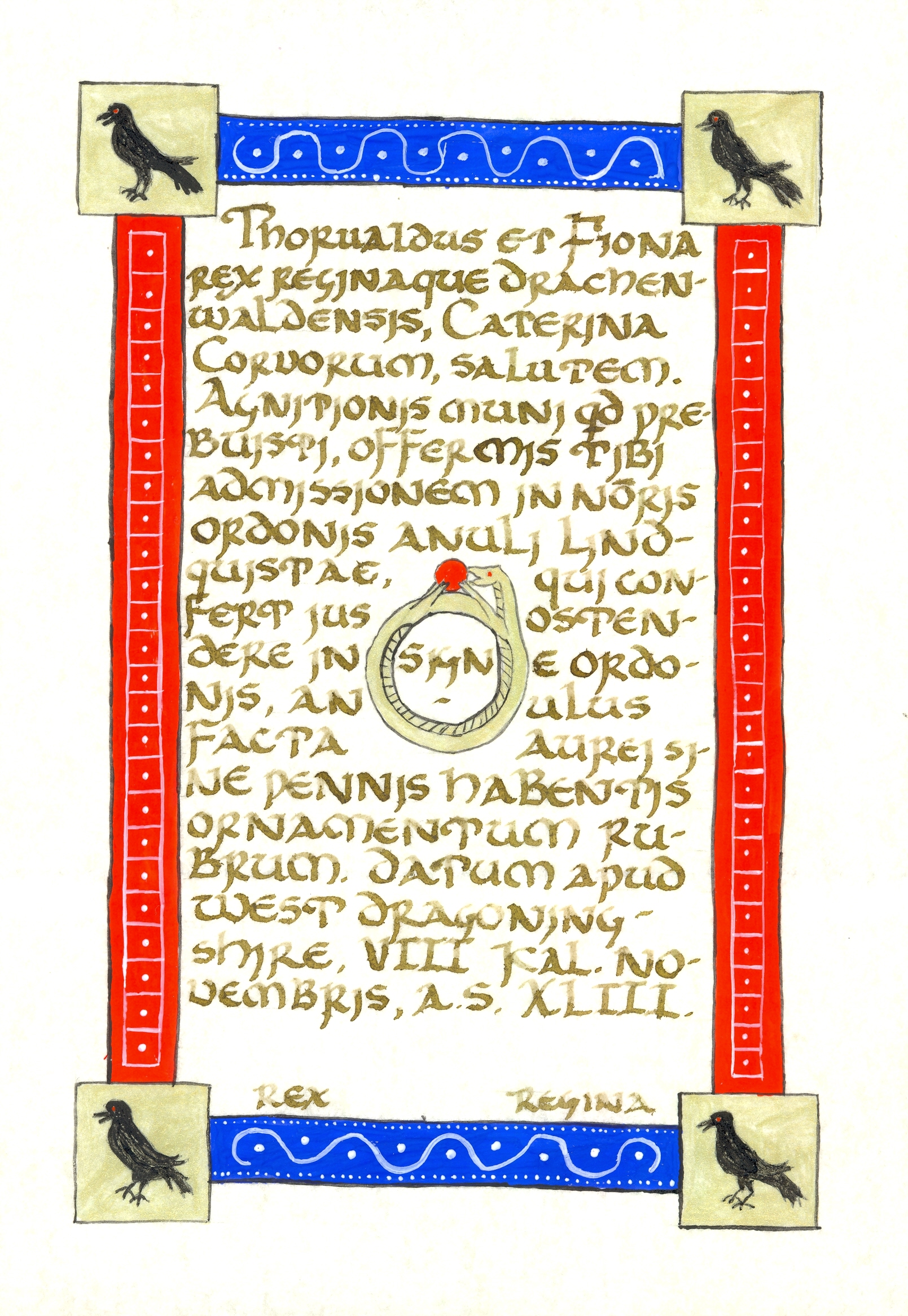
Lindquistringes for Caitriona of the Ravens

Caitriona

(The reason it looks skewed is that it wasn't square in the scanner; it really is square in real life!)

The text reads in translation Thorvald and Fiona, King and Queen of Drachenwald, to Caitriona of the Ravens, salutations. In recognition of the works that you have rendered to us, we hereby offer to you admission in our order of the ring of Lindquist, which confers the right to display the insignia of the order, a ring made of a golden dragon without wings having a red jewel. Dated by West Dragoningshire, 8th of the calendar of November, a.s. 43.

This is roughly the same translation used for the Lindquistringes for Maredudd ap Gwilym I did a month earlier. The recipient's name, Caitriona of the Ravens, naturally translates to Caterina Corvorum in Latin, though grammatically, Caterina should have bee in the dative case, which it was not (my requisite one mistake per scroll, *sigh*).

The hand is my attempt at the artificial uncial in Drogin, Medieval calligraphy: its history and technique. The design is, I have to admit, completely made up. (I'm just happy I was able to get ravens that look (sort of) like ravens!).

The scroll was done Sept. 27, 28, and Oct. 11, 12.


© 2008, Sara L. Uckelman.

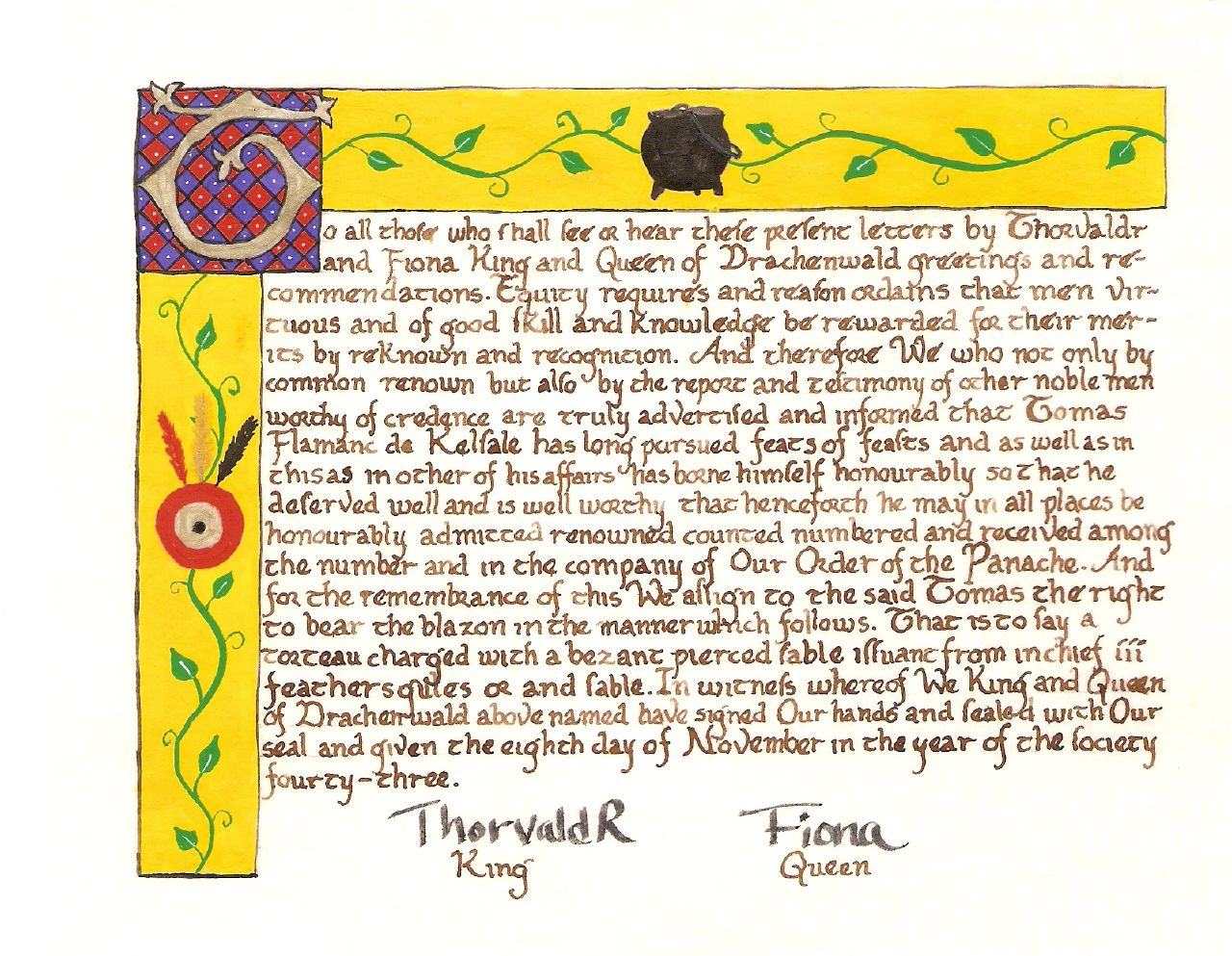
Panache for Thomas Flamance of Kelsale

Thomas

The text reads To all those who shall see or hear these present letters Thorvaldr and Fiona King and Queen of Drachenwald greeting and recommendation. Equity requires and reason ordains that men virtuous and of good skill and knowledge be rewarded for their merits by renown and recognition. And therefore We who not only by common renown but also by the report and testimony of other noble men worthy of credence are truly advertised and informed that Thomas Flamanc de Kelsale has long persued feats of food and as well in this as in other of his affairs has borne himself valiantly and conducted himself honourably so that he deserved well and is well worth that henceforth he may be in all places honourably admitted renowned counted number and received among the number and in the company of Our Order of the Panache. And for the remembrance of this we assign to the said Thomas the right to bear the blazon in the manner which follows. That is to say a torteau charged with a bezant pierced sable issuant from the chief three feathers gules, Or, and sable. In witness whereof We King and Queen of Drachenwald above named have signed our hands and sealed with our seal and given the eighth day of November in the year of the society fourty-three.. It is based on the 1459/60 grant of arms to John Alfrey, number 4 at http://verysleepy.itgo.com/grants.htm.

The illumination is based on two manuscripts in the London Guildhall library. The T is based on the one in the grant of arms to the Worshipful Company of Coopers of London, granted 1509, Guildhall Library MS 5806. The yellow border with vegetation is from the Skinners' Fraternity of Assumption, begun in the 1440s and finished in the 17th C, Guildhall Library MS 31692. The scroll was completed on 27, 28 Sept. and 11, 12 Oct.

Paints: Talens gouache, gold, yellow, green, ultramarine light, vermillion, white, and black intenso.


© 2008, Sara L. Uckelman.

Sunday, September 14, 2008

Thank you cards for the College of Arms

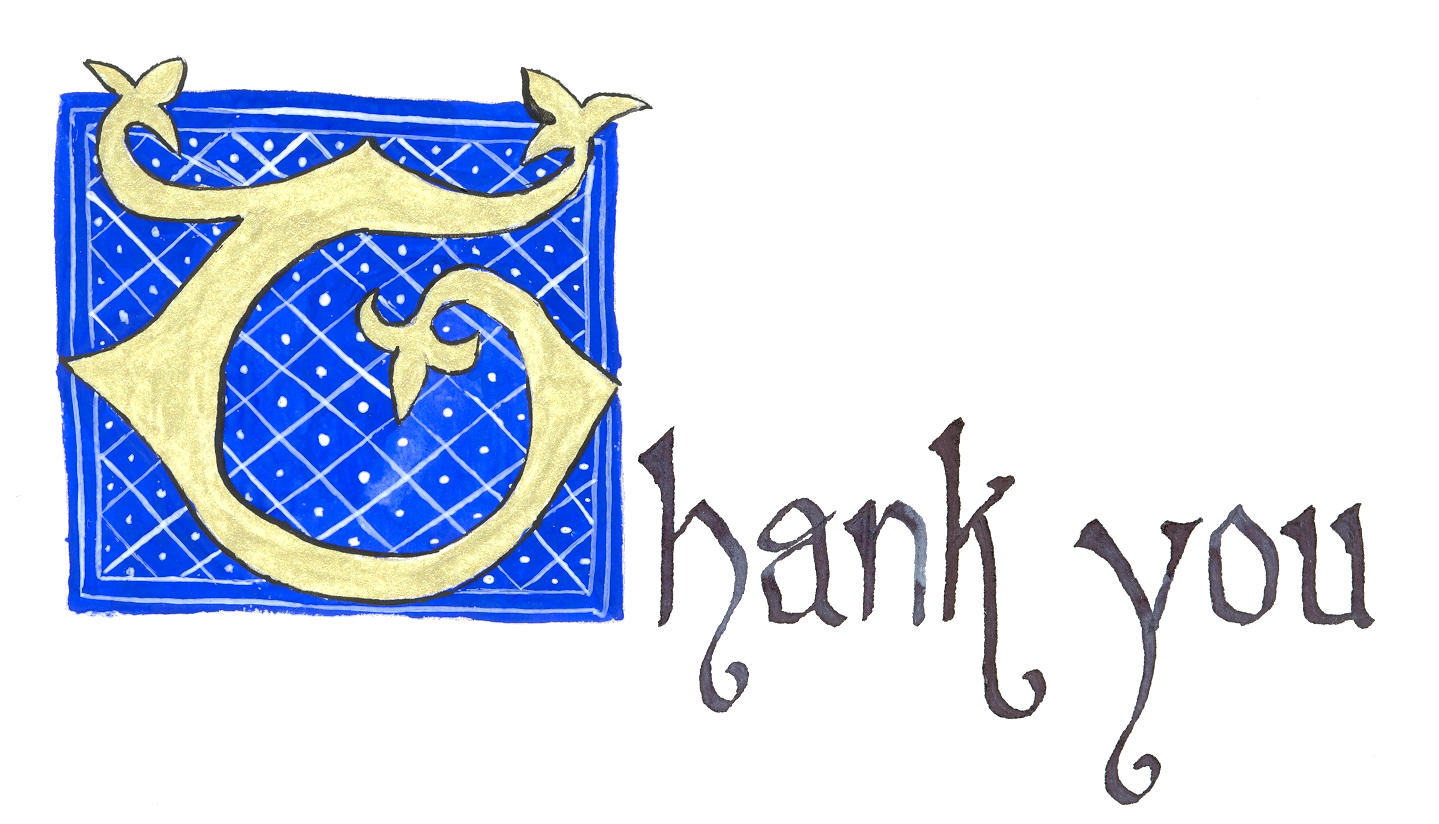
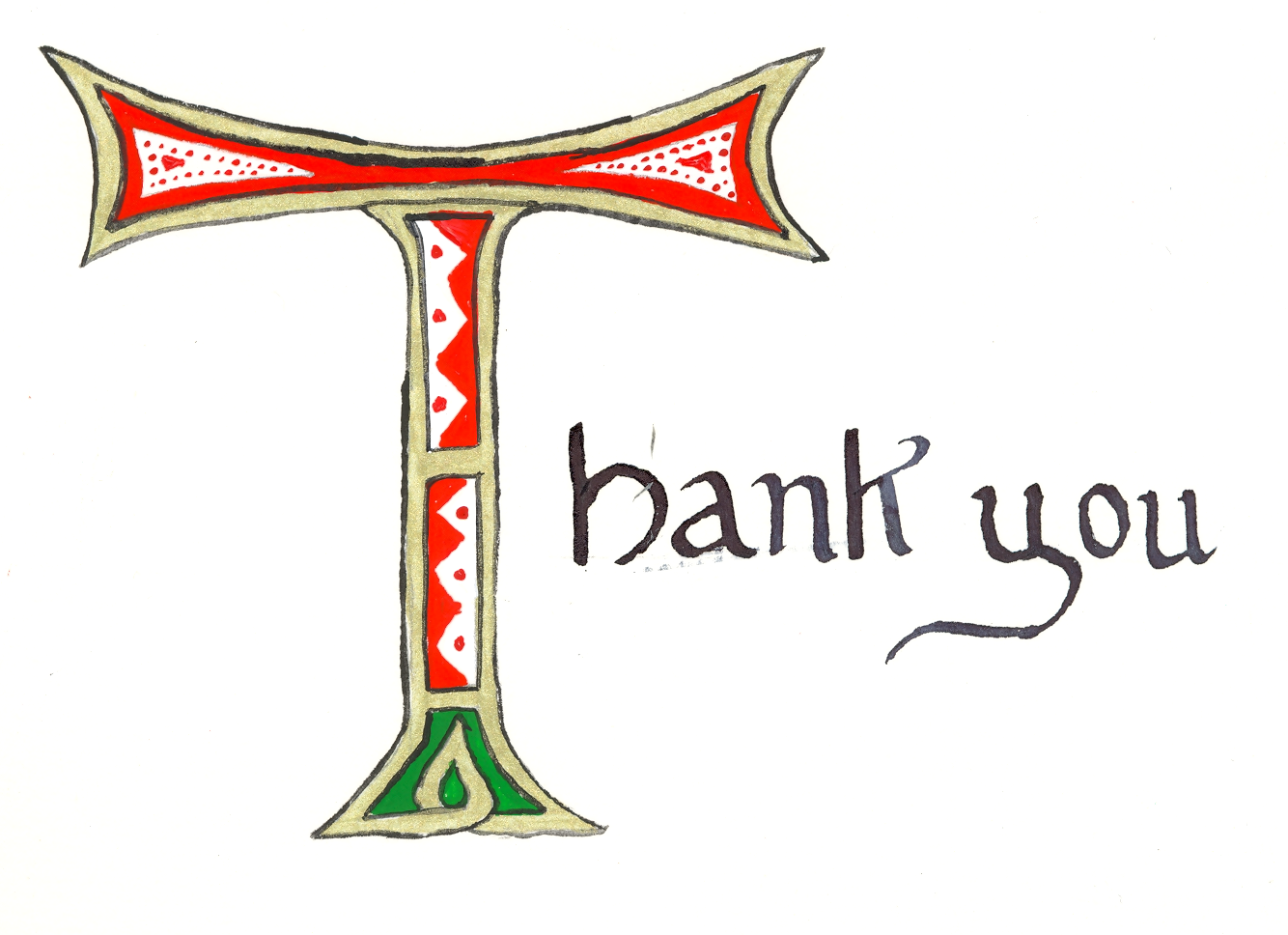
On Friday, September 5, 2008, I got to visit the College of Arms, in London, quite possibly one of the best experiences of my life. Our group of around 40 people was taken care of by Somerset Herald and Bluemantle Pursuivant, who were wonderful hosts. So I made a thank-you card for each of them:

For BluemantleFor Somerset
for Bluemantlefor Somerset
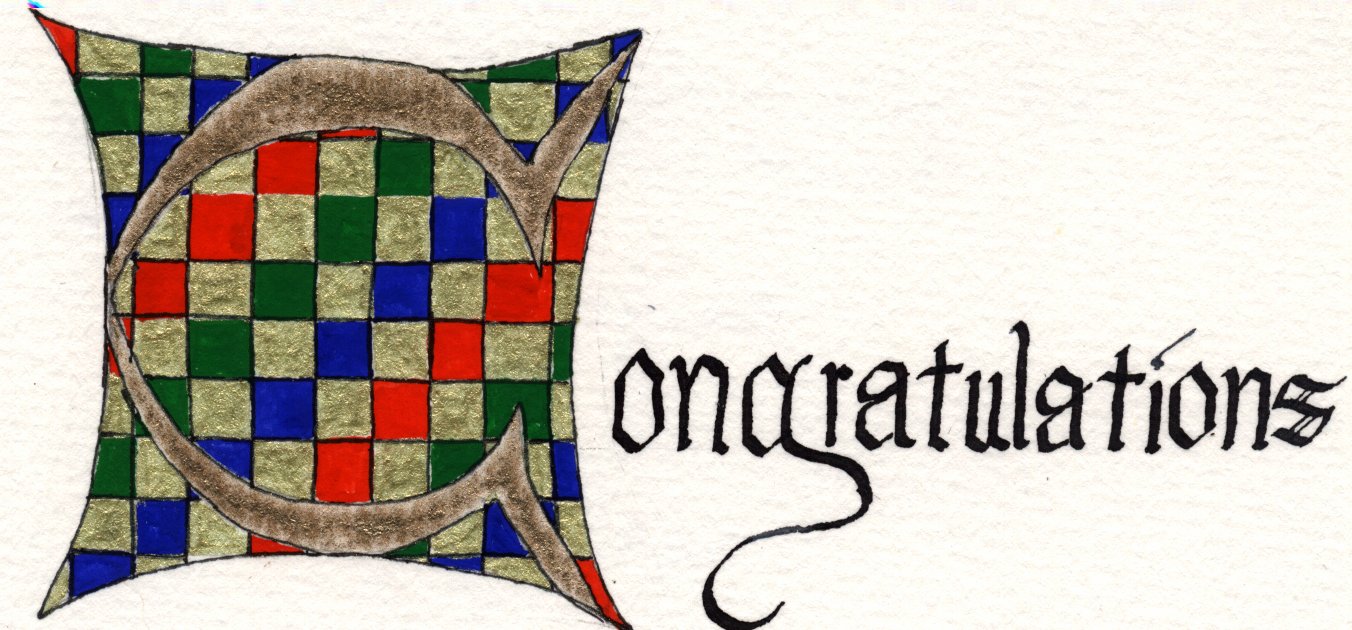
Based on MS5086, Guildhall Library, LondonLoosely based on Codex Admontensis 2,
St John's University & College of St Benedict

© 2008, Sara L. Uckelman.

Monday, September 1, 2008

Lindquistringes for Maredudd ap Gwilym

End of August/beginning of September 2008

Maredudd

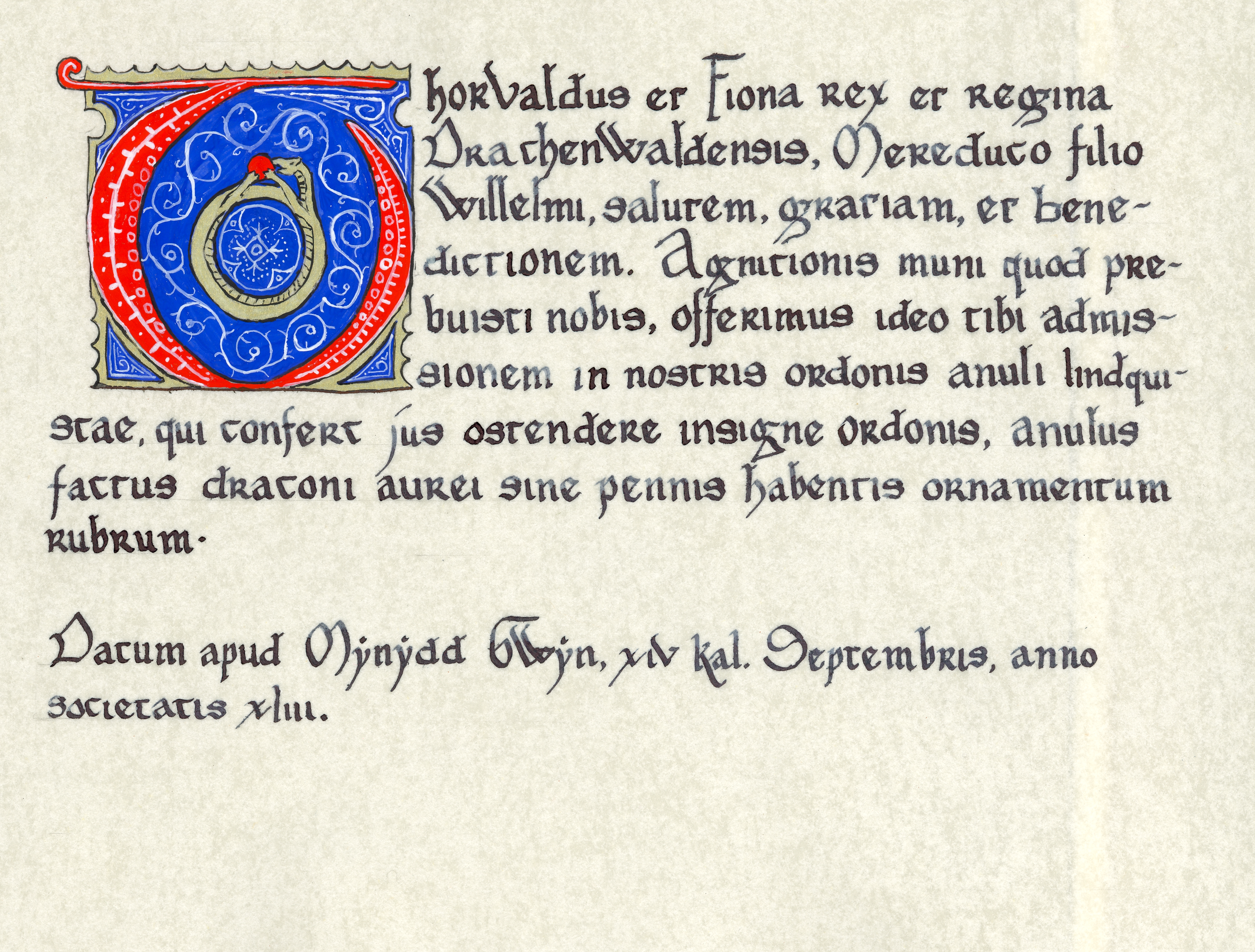
The text reads in translation Thorvald and Fiona, King and Queen of Drachenwald, to Maredudd son of William, salutations, goodwill, and blessing. In recognition of the works that you have rendered to us, we hereby offer to you admission in our order of the ring of Lindquist, which confers the right to display the insignia of the order, a ring made of a golden dragon without wings having a red jewel. Dated by Mynydd Gwyn, 13 of the calendar of September, in the year of the society 43.

Some notes on the translation: The wording of both the salutation and the conclusion comes from various texts found in the register of John Pecham, who was Archbishop of Canterbury from 1279-1292. The recipient's registered name is Maredudd ap Gwilym 'Maredudd son of William' in Welsh. It's likely that the connection between Gwilym and William would've been known even to a non-Welsh scribe, and William was standardly Latinized as Willelmus or Willielmus. Concerning how to Latinize Maredudd, Morgan & Morgan, Welsh Surnames s.n. Maredudd had some useful advice:

"The name is frequently disguised in the records written by non-Welsh scribes and takes the form Mereduc. There was another name, Moreiddig...Confusion of these two names might be part of the reason, but the general use of 'Mereduc' owes more to its suitability for taking Latin case-endings."

And they give an example of Mereduco filio Griffini from Edward I.

The order referenced in the text is Drachenwald's service order, Orden des Lindquistringes, whose registered badge is "(Fieldless) A ring formed of a wingless dragon in annulo widdershins Or, maintaining in chief with all four legs and mouth a gem gules." As you can see, much of the details of the blazon were left out in the Latin version; I figured with an image of the insignia on the scroll itself, this would be ok.

I based the hand on the one used in the Black Book of Carmarthen (currently located in the National Library of Wales); it was composed around 1250. The manuscript was written in Welsh, rather than Latin as my scroll was, so the overall visual effect of the two pieces is rather different; Welsh has a lot more ys and ws than Latin.

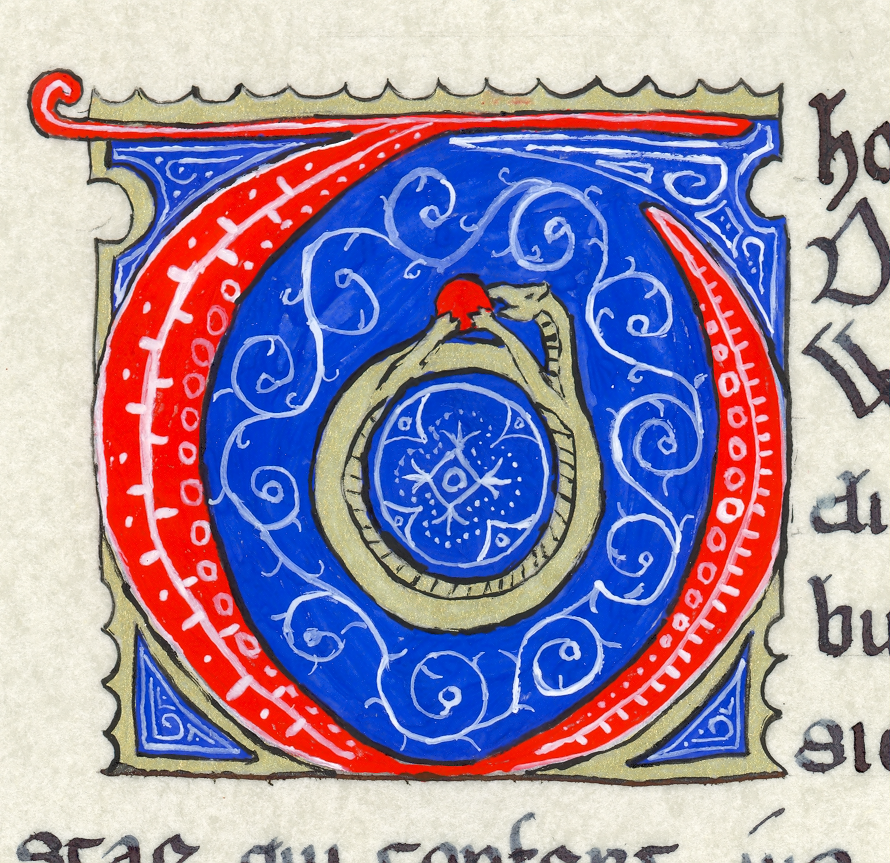
Close-up of the letter. The illuminated letter was based (loosely) on some exemplars in the De Grey Hours (also in the National Library of Wales); it's from the mid-15th century, so it's temporal inconsistent with the rest of the piece, but I didn't really see anything from the 13th century that I would actually be able to do. The gold outline, the shape and color of the letter, and the whitework are based primarily on this letter. The inner whitework design was completely made up.

Paints: Talens gouache, gold, vermillion, ultramarine light, white, and black intenso.


© 2008, Sara L. Uckelman.

Friday, August 15, 2008

AoA for Simona di Piero Valentini

Simona

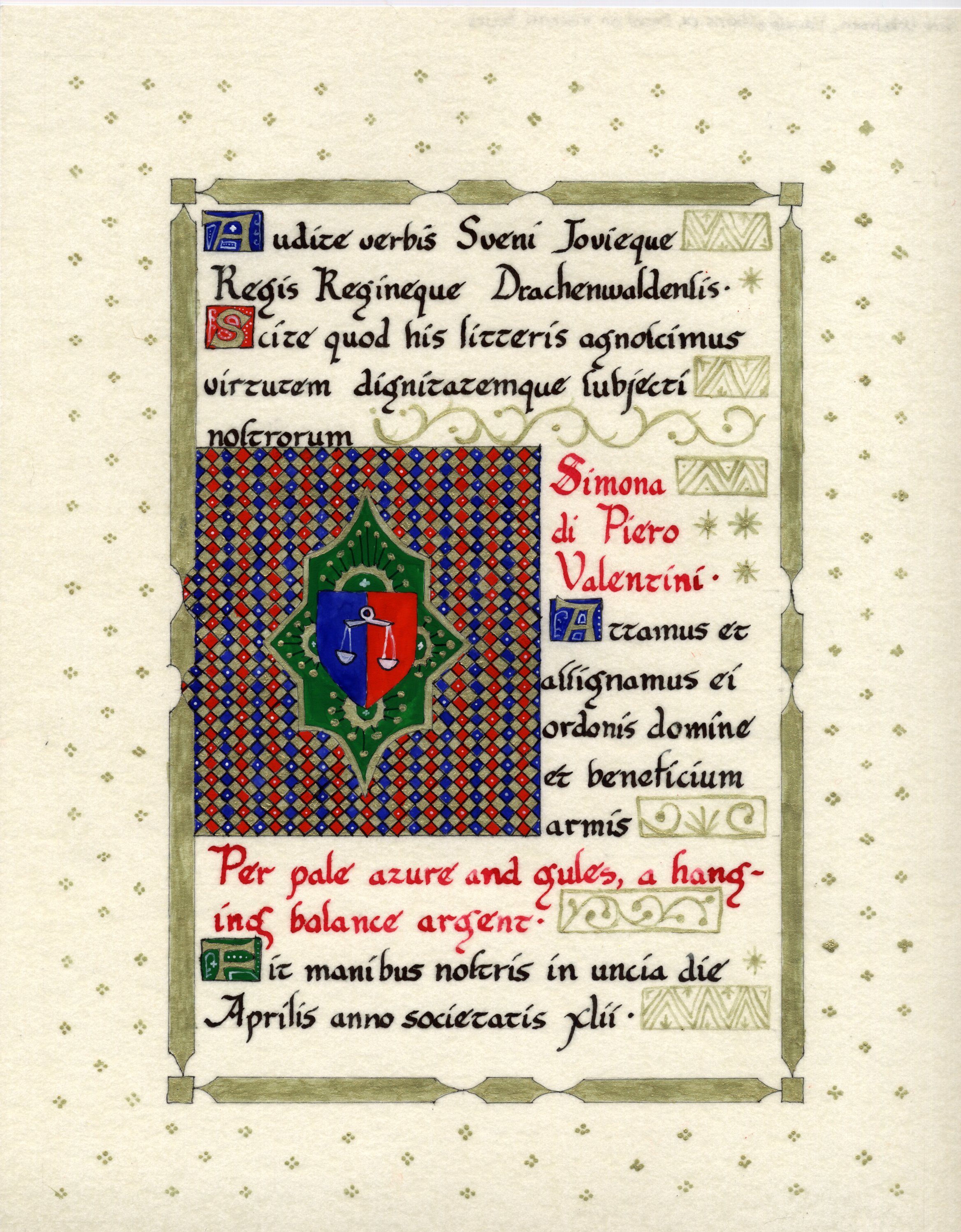
The text reads in translation Pay heed to the words of Sven and Jovi, King and Queen of Drachenwald. Know that by these letters we recognize the worth and dignity of our subject Simona di Piero Valentini. We raise her to the rank of lady and grant to her all rights to the arms Per pale azure and gules, a hanging balance argent. Done by our hands on the 11th day of April, in the year of the society XLII.

The design is based on various pages from the Visconti Hours. The gold bars and the outer floral design comes from BR 115; the border around the text is from LF18; and the framework for the arms from LF 40v. I also took the capitals from some place in the Hours, I just don't remember where at this point. The background for the arms was supposed to be diagonal rows of blue and red, not vertical, but I didn't remember that I wanted to do this until I had all the blue and a quarter of the red painted. So now I just tell myself I planned it this way, to mimic the field of the arms. The scroll was done over a number of days in July and August 2008.

Paints: Talens gouache, gold, vermillion, green, ultramarine light, and white.


© 2008, Sara L. Uckelman.

Friday, August 1, 2008